

How Did "Bloody Mary's Actions Affect The Religous Makeup
Mary I facts and myths
During her turbulent life, Mary I became the beginning ruling queen of England and attempted to restore the Catholic organized religion. Simply was she really known as 'Bloody Mary'? Find out more most the facts and myths surrounding her reign.
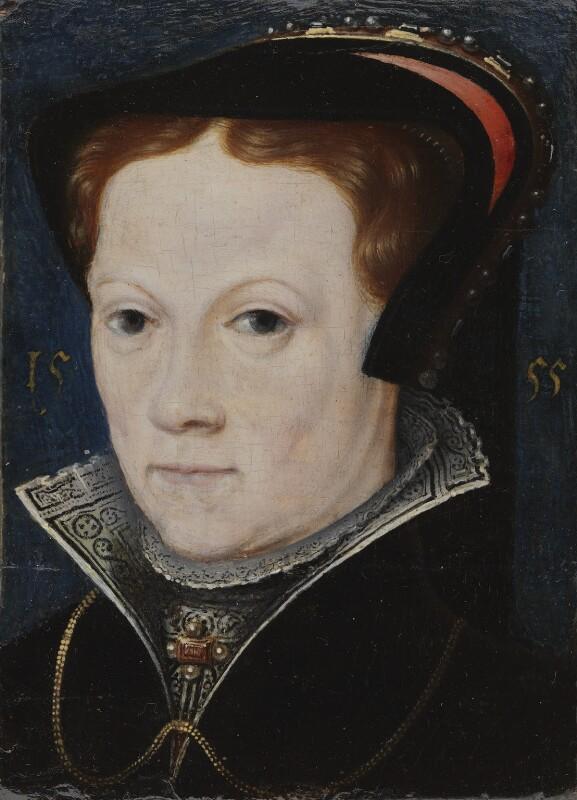
Encounter this portrait in theTudors to Windsors: British Royal Portraits major exhibition at the National Maritime Museum.
Visit the exhibition
Was Mary I the first Queen of England?
Before Mary I, in that location had been other English language queens who were the wives of the ruling rex. However, Mary was the start 'Queen Regnant' - a queen who rules a country as the principal monarch rather than just as a espoused.
When and where was Queen Mary I built-in?
Mary I was born at Greenwich Palace on eighteen February 1516. Her life every bit majestic heir, illegitimate kid and somewhen monarch ebbed and flowed around Greenwich.
Mary was not only built-in at Greenwich Palace, only was also baptized there, in the Franciscan Observant Friars church (at the w end of the palace). Her parents, Henry VIII and Catherine of Aragon, had married there seven years before.
Find more royal history in Greenwich
Was Mary I really engaged to be married aged 2?
Yes. On 5 October 1518, the two-twelvemonth-old Mary was at Greenwich for a betrothal ceremony to Francois, Dauphin of France, who was also only two at the time.
The Lord Admiral of French republic acted as the Dauphin's proxy, placing a diamond ring on her finger. Mary is said to have asked, 'Are you the Dauphin of France? If you are I wish to kiss yous'. Ii days later, the celebrations at Greenwich included jousts, a pageant in the Hall, and a feast of 260 dishes.
Yet this date, similar many of Mary's other engagements, was short-lived. It was cancelled 3 years later on in 1521.
A new treaty bundled a possible union to her 22-year-old cousin Charles V, the Habsburg Holy Roman Emperor. The following twelvemonth, Charles spent vi weeks in England and was welcomed at Greenwich with even greater ceremony. Nonetheless, while this visit gave Charles ample time to come across the vi-twelvemonth-old Mary, this engagement too was cancelled a few years later
Was Mary illegitimate?
Henry's divorce from her mother, his remarriage to Anne Boleyn, and Anne'southward execution in 1536 made Mary's childhood highly volatile. Declared illegitimate by her father, she spent time largely confined at Hatfield House in Hertfordshire until Henry VIII's third wife Jane Seymour promoted reconciliation.
From then on Mary returned to spending fourth dimension at Greenwich along with the other regal palaces. Henry restored her to the line of succession in 1544 nether encouragement from his last wife Catherine Parr.
However, with Henry self-proclaimed head of the Church building of England, this rehabilitation was a somewhat uneasy ane, equally Mary remained a loyal Catholic. Her Catholicism would get the guiding principle of her reign - and would ascertain her reputation following her death.
Was Mary I really known as 'Bloody Mary'?
Following the death of Edward Six, there was a bid to place his Protestant cousin Lady Jane Grayness on the throne of England. However, 9 days subsequently Jane's accession, Mary gathered enough support to ride to London and claim the throne. Jane and her hubby Lord Dudley were both executed.
Mary was crowned on one October 1553, and quickly set about attempting to restore the Roman Catholic faith in England.
Ane of her first acts was to marry Prince Philip of Spain (the future Philip II) in 1554. She pushed the union through a resistant parliament, as she was drastic to conceive a Catholic heir. Philip was given the championship of 'King of England' and the pair finer ruled together.
This was an unpopular movement, but an uprising confronting Mary'southward rule in 1554 - known as the 'Wyatt Rebellion' - was apace quashed. Mary's half-sister Elizabeth - the time to come Elizabeth I - was later on imprisoned in the Belfry of London for several months, but no conclusive evidence that she had been involved in the plot was plant.
During Mary's 5-year reign, effectually 280 Protestants were burned at the stake for refusing to convert to Catholicism, and a further 800 fled the land. This religious persecution earned her the notorious nickname 'Encarmine Mary' amidst subsequent generations.
Mary Tudor's legacy was farther tainted by the loss of Calais - England's last lands in Europe - to the French during her reign.
Mary'south reputation has become defined by her religious persecutions, yet this is partly every bit a result of later Tudor propaganda.
Although Mary thought herself significant on two occasions, both proved to be false alarms. As a result, she never conceived a Cosmic heir, and the Crown eventually passed to her Protestant one-half-sister Elizabeth following her death.
There is evidence that Mary'southward religious acts were not pop during her reign too however. In Greenwich for example, she reinstated the Observant Friars, whose friary Henry had dissolved in the 1530s. In July 1555, two senior friars complained of being stoned by local 'lewd persons' when arriving back from London.
Visit the Woburn Treasures exhibition at the Queen's House
When did Mary I die?
By 1558, growing increasingly sick and weak, she was forced to acknowledge her Protestant half-sister Elizabeth as her legitimate heir. Mary died at St James's Palace on 17 November 1558.
Source: https://www.rmg.co.uk/stories/topics/mary-i-facts-myths
Posted by: sieggonvegred.blogspot.com
0 Response to "How Did "Bloody Mary's Actions Affect The Religous Makeup"
Post a Comment